
Family History of Breast Cancer? Understanding High-Risk Screening in Ontario

By Kamandeep Chhabra, CCPA, MRT(N) — Director of Operations & Physician Relations, Limeworth X-Ray & Ultrasound, Hamilton
If breast cancer runs in your family, chances are you’ve wondered whether you should be starting screening earlier — or getting checked more often — than everyone else. For some women, the answer really is yes, and Ontario has a dedicated High Risk Ontario Breast Screening Program built for exactly that. Here’s how to tell if it applies to you.
Average Risk vs. High Risk
Most women are average risk. For them, the OBSP recommends a screening mammogram every two years from 40 to 74, and they can book themselves in.
A smaller group carries a genuinely higher lifetime risk — usually because of a known gene change, a strong family history, or past radiation to the chest. For these women, standard screening may not be enough, and starting earlier with more intensive screening is recommended.
Who Qualifies for the High Risk OBSP
The High Risk OBSP is for people aged 30 to 69 who have a referral from their primary care provider, a valid OHIP number, no breast symptoms, and who meet the criteria in one of two categories.
Category A — Direct Entry
You may qualify right away if you:
Are a known carrier of a gene change that raises breast cancer risk (like BRCA1, BRCA2, TP53, or PALB2)
Haven’t been tested yourself, but have had genetic counselling as a first-degree relative of a known carrier
Have been assessed by a genetics clinic as having a 25% or greater lifetime risk (using tools like IBIS or CanRisk)
Had radiation therapy to the chest before age 30, and at least 8 years ago
Category B — Genetic Assessment First
You may be sent for genetic assessment first (and then join the program if you’re eligible) if you have:
A known breast-cancer gene change in a close blood relative, or
A personal or family history that points to a hereditary breast cancer syndrome
What High-Risk Screening Looks Like
If you qualify, the program recommends screening every year with both a mammogram and a breast MRI (or a breast ultrasound, if MRI isn’t suitable for you). The MRI adds sensitivity for women at high risk, while the mammogram stays an essential part of the picture.
How to Start the Conversation
You don’t have to sort this out on your own. Before your next appointment, it helps to:
Map out your family history — who had breast or ovarian cancer, and how old they were. Both your mom’s side and your dad’s side count.
Note any gene results in the family, like a known BRCA variant.
Ask your family doctor or nurse practitioner whether a genetics referral or the High Risk OBSP is right for you.
And even if you don’t meet the high-risk criteria, a family history can still be a good reason to talk about starting screening before 40. It’s always worth raising.
Where We Fit In
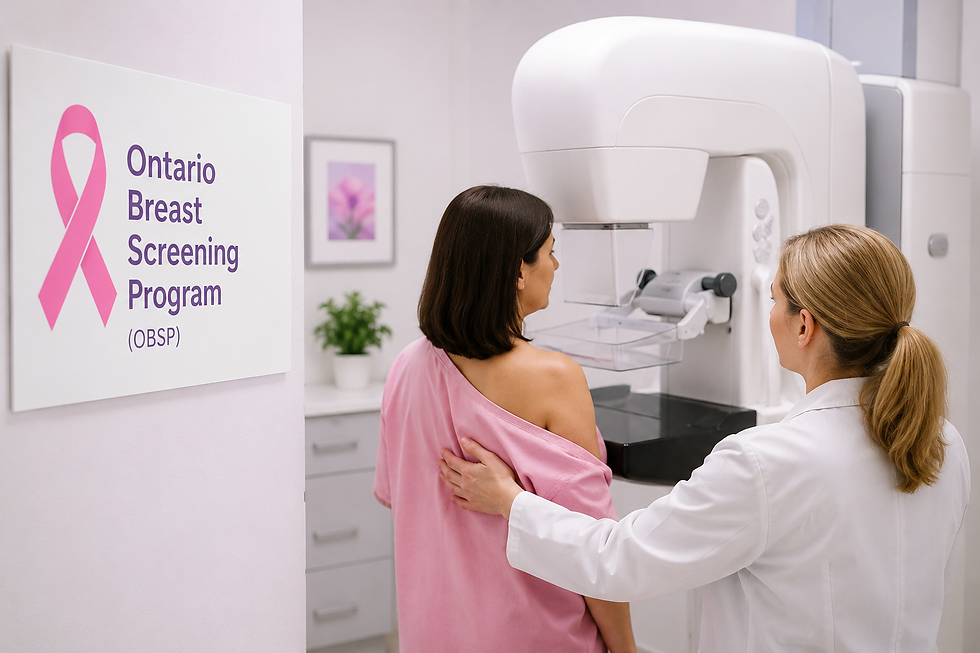
At Limeworth, we handle the mammography and breast ultrasound parts of screening, right here on the Hamilton Mountain near CF Lime Ridge Mall. If you’ve got a requisition for a screening or diagnostic mammogram or a breast ultrasound, we offer fast, comfortable appointments — Saturdays included — with experienced female technologists. |
Frequently Asked Questions
If breast cancer runs in my family, when should I start mammograms?
It really depends on your specific history. Some women qualify for the High Risk OBSP as early as 30. Talk to your doctor — a family history can be a good reason to start before the usual age of 40.
Do I need a referral for the High Risk OBSP?
Yes. Regular average-risk screening lets you self-refer from 40 to 74, but the High Risk OBSP needs a referral from your primary care provider, plus you have to meet the eligibility criteria.
How is high-risk screening different from regular screening?
Average-risk screening is a mammogram every two years. High-risk screening is done yearly and adds a breast MRI (or ultrasound) to the mammogram for extra sensitivity.
Can I get my high-risk mammogram and ultrasound at Limeworth?
Yes. We do the mammography and breast ultrasound parts with fast appointments. The breast MRI is done at a hospital imaging site, which your care team can arrange.
Limeworth X-Ray & Ultrasound is a proudly OBSP-participating, ICHSC-accredited diagnostic clinic on the Hamilton Mountain, conveniently located near CF Lime Ridge Mall with Dynacare bloodwork right across the hall. Our experienced, compassionate female mammography technologists, modern digital mammography, and fast appointments (including new Saturday availability) make breast screening easy. To book: Email your phone number and your doctor’s requisition to 849xray@gmail.com, or call 905-574-7755. Women aged 40–74 can self-refer for an OBSP screening mammogram — no doctor’s referral needed. 📍 Suite 102, 849 Upper Wentworth St, Hamilton, ON L9A 5H4 | Mon–Fri 8am–6pm, Sat 8am–4pm | Serving Hamilton, Ancaster, Dundas, Stoney Creek, Waterdown, Burlington, Binbrook, Flamborough, Brantford & Paris. |


Comments